
For most residential fence projects, a personal loan or contractor-offered financing is the fastest and most practical path. If your project tops $10,000 and you have at least 20% equity in your home, a home equity loan or HELOC will typically get you a lower rate, though you'll wait two to six weeks for funding.
- Personal loans fund in a few days, carry variable APRs for good credit, and require no collateral. Best for smaller projects where speed matters.
- Contractor financing (point-of-sale) approves quickly and often includes promotional periods, but the contractor pays a dealer fee that may be included in your financed price.
- Home equity loans / HELOCs offer generally lower APRs but take a few weeks to close and use your home as collateral.
- National average fence costs run $12–$60 per linear foot installed, so a 100-ft fence typically costs between $1,200 and $6,000 depending on material.
- The IRS treats a residential fence as a capital improvement, not an immediate deduction. It raises your home's cost basis and can reduce capital gains tax when you sell.
- The CFPB is the federal reference for comparing loan disclosures and understanding your rights as a borrower.
Pro Tip: Before signing any contractor financing agreement, ask directly: "Is the financed price the same as the cash price?" A contractor who pays a 5% dealer fee to a lender may quietly add that cost to your invoice. Get both prices in writing.
Table of Contents
- What are your fence financing options?
- How do the main options compare side by side?
- How do you choose the right financing for your fence?
- How does contractor financing actually work?
- What does a fence actually cost, and what are the monthly payments?
- How does a fence affect your taxes and home value?
- Which financing route is right for your situation?
- Key Takeaways
- The real trade-off most homeowners miss
- Advantagefencenj walks you through financing at every estimate
- Useful sources for further research
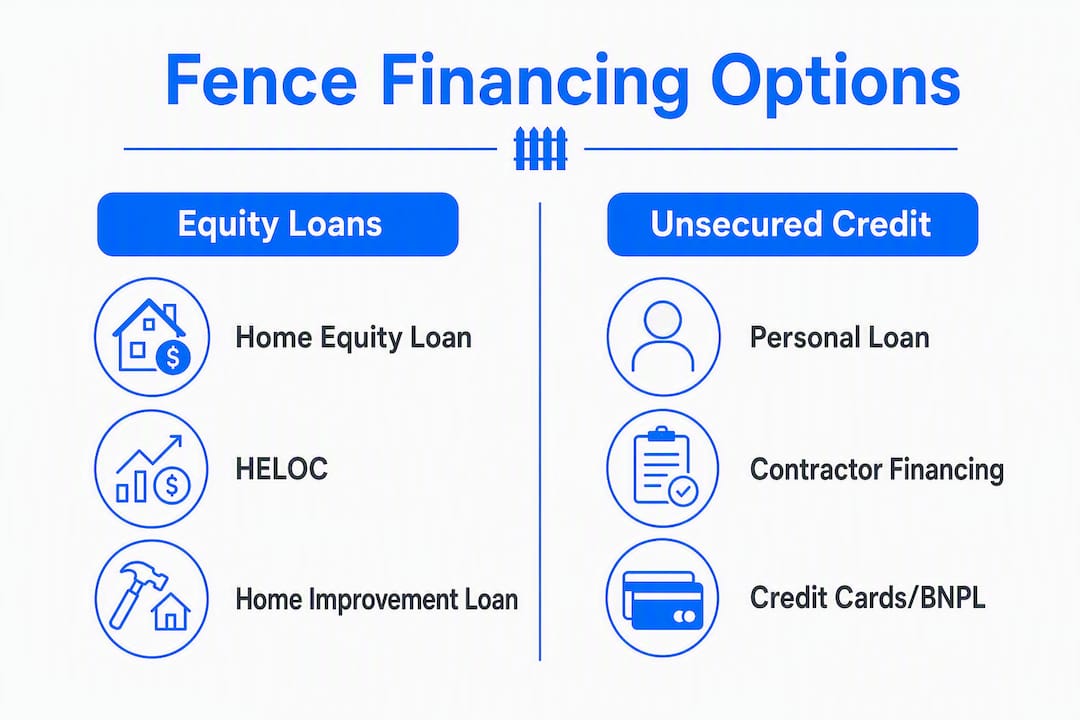
What are your fence financing options?
Several options exist for funding a fence installation, each fitting different project sizes, credit profiles, and timelines. Here is what each actually looks like in practice.
Home equity loan and HELOC
Both products let you borrow against the equity you have built in your home. A home equity loan gives you a lump sum at a fixed rate; a HELOC works more like a credit card with a draw period. Either way, APRs typically run 6–9% and funding takes two to six weeks.
Best for: Projects of larger size where the homeowner has some home equity and can wait for closing.
Pros: Lowest rates of any fence financing route; interest may be deductible if the loan is used to improve the home (confirm with a tax professional).
Cons: Your home is collateral. A missed payment can eventually trigger foreclosure. The closing timeline rules this out for anyone who needs work started within a week or two.
Personal (unsecured) loan
An unsecured personal loan is the workhorse of fence financing. No collateral, no appraisal, no waiting for a bank to schedule a home visit. Lenders like LightStream, SoFi, and Marcus by Goldman Sachs can fund in one to five days. APRs run roughly 7–15% for borrowers with good credit, and loan amounts commonly range from $1,000 to $50,000.

Best for: Small-to-medium projects ($2,000–$15,000) where the homeowner wants speed and does not want to risk the house.
Pros: Fast, no collateral, fixed monthly payment, predictable payoff date.
Cons: Higher APR than a HELOC; approval depends heavily on credit score and debt-to-income ratio.
Contractor-offered (point-of-sale) financing
When a contractor says "we offer financing," they almost always mean a third-party lender like Wisetack, Hearth, GreenSky, or Service Finance has integrated into their sales process. You apply on a tablet at the estimate appointment, get a decision in minutes, and the lender pays the contractor directly. You then repay the lender.

Promotional 0% periods are common, typically six to eighteen months. After the promo ends, APRs can jump to 15–29%. The contractor pays a dealer fee of 2–8% to the lender for this convenience, and that fee is sometimes passed to you through a higher invoice price.
Best for: Homeowners who want same-day approval and are confident they can pay off the balance before the promotional period ends.
Pros: Instant approval, no separate lender search, promotional 0% periods.
Cons: Post-promo APR can be steep; dealer fee may inflate the financed price; retroactive interest applies if the balance is not cleared by the promo deadline.
Home improvement loans
Some banks and specialty lenders (Regions Bank's EnerBank, for example) offer home improvement loans specifically designed for contractor projects. These sit between personal loans and HELOCs in terms of rate and structure. They are often unsecured but underwritten with the home improvement context in mind, which can mean slightly better terms than a generic personal loan for the same borrower.
Best for: Homeowners whose bank offers a dedicated product and who want a purpose-built loan without tapping equity.
Credit cards and 0% intro offers
A credit card with a 0% introductory APR (typically 12–21 months) can work well for a smaller fence project if you are disciplined about paying the balance before the promo expires. After that window, APRs typically run 18–29%, which makes long-term revolving debt on a fence project expensive fast.
Best for: Projects under $3,000 where the homeowner can realistically zero the balance within the intro period.
Cons: High post-promo APR; credit utilization impact on your score; no fixed payoff date creates repayment risk.
Buy Now, Pay Later (BNPL)
Service-oriented BNPL platforms like Wisetack and Affirm are increasingly used for home improvement. Wisetack offers 3–60 month terms with APRs from 0–29%; Affirm runs 0–36% APR depending on the plan. PayPal Pay Later splits smaller amounts into short-term installments.
Best for: Homeowners comfortable with app-based lending who want flexible short-term terms on smaller projects.
Cons: APRs vary widely; missing a payment can trigger the full rate immediately; not all fence contractors accept BNPL platforms.
Cash and savings
Paying cash avoids all interest and fees. It also gives you negotiating leverage. A contractor who does not need to wait for lender disbursement may offer a modest discount for cash payment.
Best for: Homeowners with liquid savings who want the lowest total cost and no debt obligation.
One thing worth considering: if your savings are earning a meaningful return in a high-yield account, the opportunity cost of pulling cash for a $10,000 fence is real. Run the math against a low-APR personal loan before assuming cash is always the right call.
Statistic: National installed fence costs vary broadly per linear foot, with all-in project totals for typical residential jobs covering a wide range.
How do the main options compare side by side?
| Financing type | Typical APR | Loan term | Secured? | Speed to fund | Best project size | Effect on home equity | Credit sensitivity | Common fees |
|---|---|---|---|---|---|---|---|---|
| Home equity loan | 6–9% | 5–15 years | Yes | 2–6 weeks | $10,000+ | Reduces equity | Moderate | Closing costs |
| HELOC | 6–9% variable | 10–20 years | Yes | 2–6 weeks | $10,000+ | Reduces equity | Moderate | Annual fee possible |
| Personal loan | 7–15% | 2–7 years | No | 1–5 days | $1,000–$50,000 | None | High | Origination fee (0–8%) |
| Contractor financing | 0% promo, then 15–29% | 6–84 months | No | Minutes | $2,000–$15,000 | None | Moderate | Dealer fee (2–8%) |
| Home improvement loan | 7–14% | 2–12 years | Sometimes | 3–10 days | $3,000–$15,000 | Varies | Moderate–High | Origination fee |
| Credit card (0% intro) | 0% then 18–29% | Revolving | No | Immediate | Under $3,000 | None | High | Late fees |
| BNPL (Wisetack/Affirm) | 0–29% | 3–60 months | No | Minutes | $1,000–$15,000 | None | Low–Moderate | Varies |
| Cash/savings | 0% | N/A | No | Immediate | Any | None | None | None |
Quick filters by project size:
- Small project (under $3,000): Cash, credit card with 0% intro, or BNPL. Keep it short-term and pay it off fast.
- Medium project ($3,000–$10,000): Personal loan or contractor financing. Personal loan wins on transparency; contractor financing wins on speed.
- Large project ($10,000+): Home equity loan or HELOC if you have equity and a flexible start date. Personal loan if you need to move quickly and prefer no collateral.
The buying guide below walks through exactly how to evaluate these options once you have a contractor estimate in hand.
How do you choose the right financing for your fence?
Getting the right loan is mostly about asking the right questions before you sign anything. Here is a prioritized process.
Step-by-step checklist
- Confirm project scope and permits. Know the exact linear footage, material, gate count, and whether your municipality or HOA requires a permit before you apply for financing. Locking a loan before permits are approved means interest may start accruing before a single post goes in the ground.
- Get three contractor bids. Prices vary more than most homeowners expect. Three bids give you a realistic number to finance and leverage to negotiate.
- Check your credit score. Pull your free report at AnnualCreditReport.com. A score above 700 opens the best personal loan rates; below 620, contractor financing or a secured product may be your most realistic path.
- Compare APR, not just monthly payment. A longer term lowers the monthly payment but raises total interest paid. Always compare the total cost of capital across offers.
- Ask whether the financed price equals the cash price. This one question can save you hundreds of dollars if the contractor is passing a dealer fee through to your invoice.
- Verify disbursement timing. Confirm when the lender pays the contractor. Some products fund at signing; others fund at project completion. Know which one you are agreeing to.
- Read the prepayment terms. Some loans carry prepayment penalties. If you plan to pay off early, confirm there is no fee for doing so.
Questions to ask lenders and contractors
- What is the exact APR (not just the promotional rate)?
- Are there origination fees, dealer fees, or closing costs?
- When does interest begin accruing — at signing or at project completion?
- Is there a prepayment penalty?
- What happens if the project is delayed or canceled after funding?
- Who is the actual lender behind the contractor's financing offer?
- Does the contractor receive full payment upfront, or in draws tied to project milestones?
Red flags to watch for
- No written loan terms before you sign the contract.
- A contractor who cannot name the lender behind their financing program.
- Interest that starts accruing before installation begins.
- A financed price that is higher than the cash price with no explanation.
- Pressure to sign same-day without time to review the loan agreement.
Sample monthly payment calculation
The standard formula for a fixed installment loan monthly payment is:
M = P × [r(1+r)^n] / [(1+r)^n − 1]
Where M is the monthly payment, P is the principal, r is the monthly interest rate (annual APR divided by 12), and n is the number of months.
Worked example: A $7,000 personal loan at 10% APR over 36 months.
- Monthly rate: 10% / 12 = 0.833%
- M = $7,000 × [0.00833 × (1.00833)^36] / [(1.00833)^36 − 1]
- M ≈ $226 per month
- Total paid: ~$8,136 (about $1,136 in interest)
For a $15,000 project at the same rate and term, the monthly payment scales to roughly $484, with total interest around $2,424.
Pro Tip: Always calculate the total cost of capital, not just the monthly payment. A contractor financing offer at 0% for 12 months then 24% APR can cost more than a personal loan at 10% if you carry any balance past the promo deadline.
How does contractor financing actually work?
Contractor financing is simpler than it sounds, but the mechanics matter. Here is the flow from estimate to first payment.
- Step 1 — Application at the estimate. The contractor pulls up a financing portal (Wisetack, Hearth, GreenSky, or Service Finance) on a tablet or phone. You enter basic personal and financial information.
- Step 2 — Lender decision in minutes. The platform runs a soft or hard credit pull and returns an approval, usually with multiple term options (e.g., 12 months at 0%, 36 months at 9.9%, 60 months at 14.9%).
- Step 3 — Lender pays the contractor. Once you sign the loan agreement and the project is confirmed, the lender disburses funds directly to the contractor. You never handle the money.
- Step 4 — You repay the lender. Monthly payments go to the lender, not the contractor. The contractor's job is done once they are paid.
Dealer fees and price transparency
The contractor pays the lender a dealer fee, typically 2–8%, for access to the financing platform and the quick-close benefit. Think of it as the contractor's cost of offering you a convenient payment option. Whether that fee gets absorbed into the contractor's margin or added to your invoice depends entirely on the contractor.
Contractors often treat the dealer fee as a customer acquisition cost rather than a line item they pass through, but not all of them. Asking "Is the financed price the same as the cash price?" is the only reliable way to find out.
Promotional terms and retroactive interest
A 0% promotional offer is only free if you pay the full balance before the period ends. Many contractor financing products use deferred interest, not true 0% financing. If even $1 remains at the end of the promo period, interest is calculated retroactively on the original balance from day one. That can turn a "free" 12-month offer into a significant charge.
What to confirm before accepting contractor financing:
- The name of the actual lender and their license number.
- The exact financed amount shown on your invoice.
- Whether the 0% offer is true 0% or deferred interest.
- The payment schedule and whether the contractor is paid upfront or in draws.
- The cancellation and refund process if the project is delayed or you change your mind.
Pro Tip: Ask the contractor which financing platform they use and look it up independently before the estimate appointment. Wisetack, Hearth, GreenSky, and Service Finance all publish their terms online. Knowing the post-promo APR before you sit down gives you real negotiating context.
What does a fence actually cost, and what are the monthly payments?
Installed cost by material (100-ft fence)
| Material | Per linear foot | 100-ft total (est.) | Notes |
|---|---|---|---|
| Chain-link | $12–$20 | $1,200–$2,000 | Most affordable; minimal privacy |
| Wood privacy | $12–$60 | $1,200–$6,000 | Classic look; maintenance required |
| Vinyl | $12–$60 | — | Low maintenance; mid-to-high cost |
| Aluminum | $30–$60 | — | Durable; decorative applications |
National data puts typical all-in project totals between $8,900 and $15,500 for standard residential installations, once you factor in gates, terrain, and labor. Regional labor rates, soil conditions, and permit fees can push costs well outside those ranges.
Sample monthly payments
- $7,000 personal loan at 10% APR, 36 months: ~$226/month, ~$1,136 total interest.
- $7,000 contractor financing at 0% for 12 months: ~$583/month to clear the balance before the promo ends; $0 interest if paid in full.
- $15,000 personal loan at 10% APR, 36 months: ~$484/month, ~$2,424 total interest.
- $15,000 HELOC at 7.5% APR, 60 months: ~$300/month, ~$3,000 total interest.
- $15,000 home equity loan at 7% APR, 84 months: ~$226/month, ~$3,984 total interest.
Timeline from application to work start
- Cash/savings: Immediate. Work can start as soon as the contractor is scheduled.
- Contractor financing (Wisetack, Hearth): Same day to 24 hours. Wisetack typically sets up in one to two days; Hearth in three to five.
- Personal loan: One to five business days for most online lenders.
- Home improvement loan: Three to ten business days depending on the lender.
- Home equity loan / HELOC: Two to six weeks, including appraisal and underwriting.
Regional variance is real. A permit in one municipality takes three days; in another, three weeks. Get your permit timeline confirmed before you lock a financing start date. For a realistic local cost estimate, get at least three bids from licensed contractors in your area.
For a broader look at how renovation financing fits into your overall home improvement budget, the renovation financing guide at House A-Z covers related exterior projects in useful detail.
How does a fence affect your taxes and home value?
Residential homeowners: capital improvement, not a deduction
A new fence on your primary residence is not tax deductible in the year you install it. The IRS classifies it as a capital improvement, which means it increases your home's cost basis. When you eventually sell, a higher cost basis reduces your taxable capital gain. IRS Publication 530 covers what qualifies as a capital improvement for homeowners.
The practical implication: keep your contractor invoice and proof of payment permanently, not just for the current tax year. You will need them when you sell.
Rental and business property: depreciation applies
For rental or business property, the tax treatment is meaningfully different. Under MACRS, fences are classified as 15-year land improvements for most nonfarm commercial and rental applications. Farming operations may use a seven-year recovery period.
For qualifying placements in 2026, many rental and business fences may be eligible for 100% bonus depreciation, allowing a full write-off in year one rather than spreading it over 15 years. Residential owner-occupied properties do not get this benefit. Confirm eligibility with a tax professional before assuming it applies to your situation.
Insurance and casualty considerations
If a storm, vehicle, or other covered event damages your fence, your homeowner's insurance may cover replacement costs minus your deductible. The claim process goes much smoother when you have:
- The original itemized contractor invoice.
- Proof of payment (bank statement or canceled check).
- Before-and-after photos showing the fence's condition.
- The date the fence was "placed in service."
Statistic: Missing documentation is the most common reason fence-related tax and insurance claims fail. Store all records digitally in a dedicated home improvement folder.
Which financing route is right for your situation?
Most homeowners fall into one of four profiles. Here is a direct recommendation for each.
- Tight timeline, small project (under $5,000): Contractor financing or a personal loan. Contractor financing wins on speed if the promotional terms are clear. Personal loan wins on transparency. Either way, you can have funds in place within 24–48 hours.
- Medium project ($5,000–$10,000), solid credit: Personal loan at 7–12% APR over 36–60 months. Clean, predictable, no collateral. Shop at least two to three lenders before accepting the first offer.
- Large project ($10,000+), homeowner with equity: Home equity loan or HELOC. The rate difference between a 7% HELOC and a 12% personal loan on a $15,000 project is roughly $1,200 in total interest over three years. Worth the two-to-six-week wait if your schedule allows.
- Poor credit or recent credit events: Contractor financing through platforms like Wisetack tends to have more flexible underwriting than traditional banks. A secured personal loan or a co-signer can also improve approval odds. If financing is denied outright, ask the contractor about a phased project: install the most critical section now with cash and finance the remainder later.
If you are denied financing:
Consider a smaller initial scope, a secured loan using a vehicle or savings account as collateral, or a credit union (which often has more flexible underwriting than large banks). Improving your credit before reapplying is faster than most homeowners expect.
How to improve approval odds quickly
- Pay down any credit card balances to below 30% utilization before applying.
- Bring a recent pay stub and your contractor's written estimate to the application.
- Avoid applying for multiple loans simultaneously; each hard inquiry can lower your score by a few points.
- Check your credit report for errors at AnnualCreditReport.com and dispute any inaccuracies before applying.
Pro Tip: If you are exploring whether renovation costs could be rolled into a mortgage refinance, the guidance at Platinum Capital Advisors explains how that works for exterior improvements. It is not the right move for every homeowner, but for a large project timed with a refinance, it can make sense.
Key Takeaways
A personal loan or contractor financing covers most residential fence projects efficiently; home equity products make sense only when the project is large and the timeline is flexible.
| Point | Details |
|---|---|
| Match financing to project size | Personal loans suit $1,000–$15,000 projects; home equity products work best above $10,000 with equity available. |
| Always ask about the dealer fee | Contractor financing carries a 2–8% dealer fee that may raise your financed price above the cash price. |
| Fences are capital improvements | Residential fences increase your home's cost basis but are not immediately deductible; rental fences may qualify for bonus depreciation. |
| Document everything | Keep your invoice, proof of payment, and installation photos permanently for tax and insurance purposes. |
| Advantagefencenj discusses financing at estimate time | Request a quote from Advantagefencenj to compare cash and financed pricing before committing to a loan. |
The real trade-off most homeowners miss
The conversation around fence financing almost always focuses on interest rates, and that is the wrong place to start. Rate matters, but the more consequential decision is whether to wait for a low-rate product or move quickly with a higher-rate one.
A HELOC at 7% sounds better than contractor financing at 14%. Over a $10,000 project and three years, it probably saves you around $1,100 in interest. But if waiting six weeks for the HELOC to close means losing a contractor slot in peak season, or means your dog is loose in the yard for another month, or means a commercial property sits unsecured, the math changes. The "cheap" loan can end up costing more in real terms than the fast one.
What I have seen repeatedly in this industry is homeowners who optimize for rate and underestimate the cost of delay. The better framework is to ask: what is the actual cost of waiting? If the answer is "not much," take the HELOC. If the answer involves a real inconvenience or risk, the personal loan or contractor financing at a slightly higher rate is the smarter call.
The other thing most guides skip: the dealer fee question. Contractors who offer financing are not doing it out of generosity. They pay 2–8% to the lender for that convenience, and some pass it along. Asking one direct question before you sign protects you from paying a hidden markup on a project you could have negotiated down.
Advantagefencenj walks you through financing at every estimate
A fence project should not stall because the financing conversation feels complicated. Advantagefencenj covers design, material selection, permitting assistance, and expert installation for residential, commercial, and recreational properties, and financing options are part of every estimate conversation.

When you request a quote from Advantagefencenj, you get a written estimate that shows both the cash price and the financed price side by side. No guessing whether a dealer fee has been added. No pressure to sign before you have compared your options. The team works with homeowners to match the right material and payment structure to the actual project budget, whether that is a straightforward vinyl fence installation or a larger commercial perimeter job.
Ready to see real numbers for your property? Request an estimate and ask about financing options at the same time.
Useful sources for further research
These are the primary references used throughout this guide, plus tools for running your own cost estimates.
- Fence Financing Tips (LendingTree) — Guidance on comparing personal loan offers and avoiding revolving debt traps for home improvement projects.
- IRS Publication 530 (2025) — The authoritative IRS reference for what qualifies as a capital improvement on a personal residence.