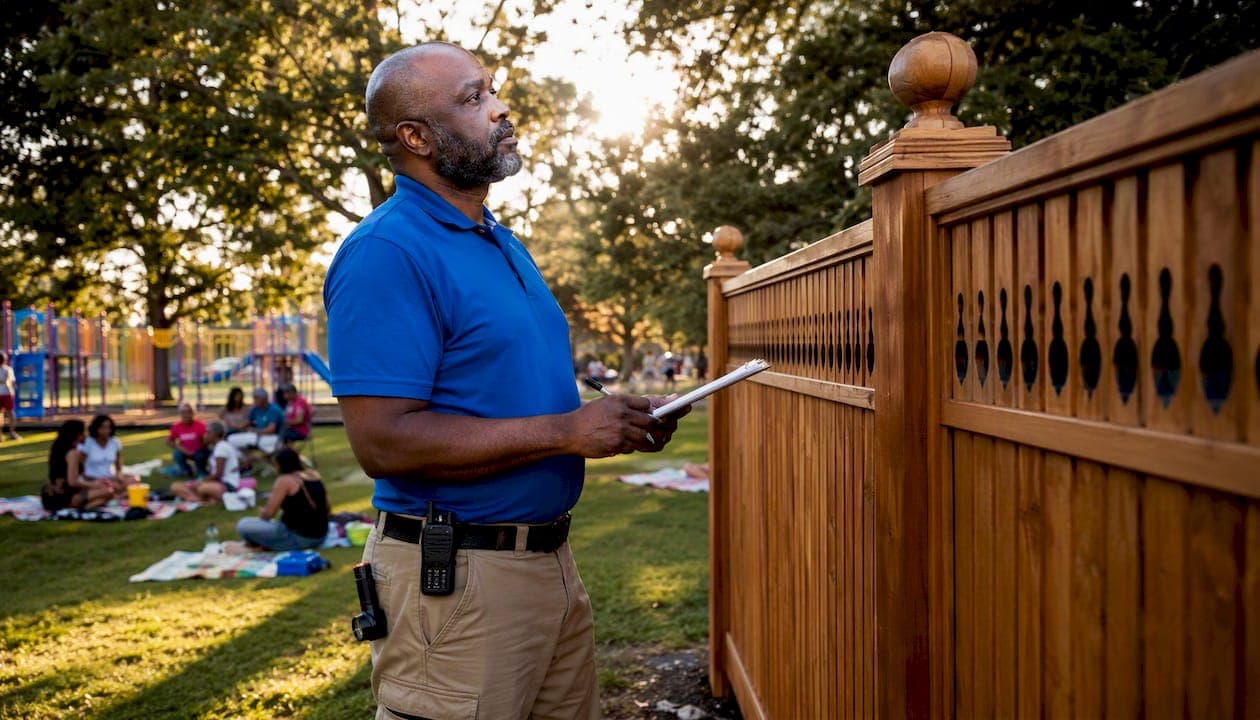
For most U.S. commercial parking lots, a commercial-grade chain-link or ornamental metal fence combined with a small number of controlled vehicle portals, bollards at pedestrian zones, and LED perimeter lighting delivers the best balance of durability, visibility, and cost. That combination satisfies the majority of municipal codes, holds up to vehicle impact and weather, and keeps your security posture visible without turning the property into a fortress.
Before you call a contractor, three things matter most:
- Material and height: Chain-link at an affordable installed cost handles utility areas; ornamental aluminum or steel at a higher installed cost works for customer-facing frontage where aesthetics count.
- Access control: Limit vehicle entry to one or two controlled portals with automated gates rated for commercial cycle volumes.
- Permits first: Most U.S. jurisdictions require a permit for commercial fences over typical heights, any masonry wall, and automated gates. Skipping this step stops projects cold.
Your immediate next steps: walk the perimeter and note sight-line gaps, lighting dead zones, and existing utility conflicts. Then contact Advantagefencenj for an on-site assessment, tailored material specs, and permit assistance before you issue an RFP.
Table of Contents
- What does good parking lot fencing actually require?
- Which fence material is right for your parking lot?
- Surface-mount versus in-ground: which installation method fits your site?
- How do gates, barriers, and bollards fit into your access strategy?
- How does fencing affect sight lines, pedestrian safety, and traffic flow?
- What permits and code checks does a commercial fence project trigger?
- What does parking lot fencing actually cost?
- How long will your fence last, and what maintenance does it need?
- How do you choose the right fence installer for a commercial project?
- Why layering fencing with lighting and video AI matters
- Key Takeaways
- The fence is the easy part
- Advantagefencenj: commercial fencing from spec to installation
- Useful sources and standards for further reading
What does good parking lot fencing actually require?
The spec that looks fine on paper often fails in the field because facility managers optimize for purchase price and overlook the attributes that drive long-term cost. Here is what to prioritize.
Durability and corrosion resistance
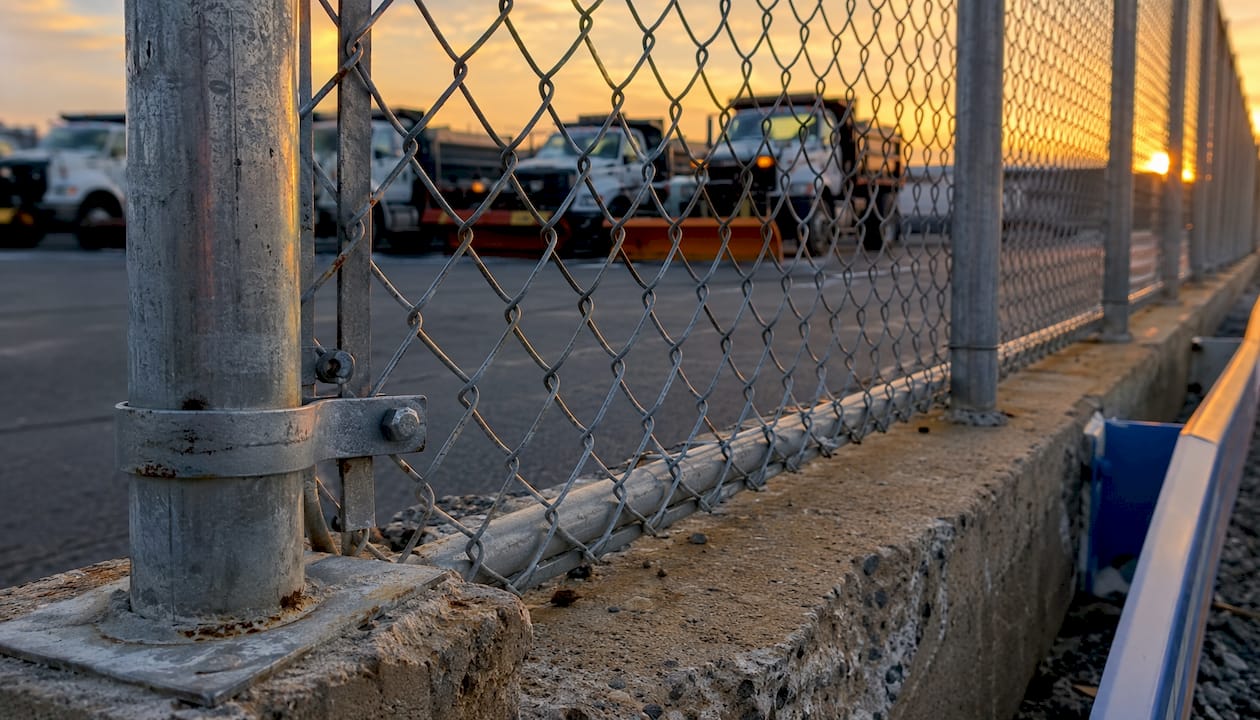
Commercial posts and fabric take more abuse than residential fencing: snowplow strikes, de-icing salt spray, vehicle overhang, and constant UV exposure. Specify G90 galvanization (0.90 oz of zinc per square foot) as the minimum for chain-link fabric and posts in any climate that sees road salt. Coastal or high-humidity sites should step up to G185 or specify powder-coated aluminum, which adds a second corrosion barrier. Powder-coat thickness matters: 2–3 mils is typical; 3–4 mils is worth specifying for high-exposure perimeters.
Visibility versus privacy
Most parking lots benefit from visual permeability, not screening. Perimeter design should prioritize visibility so that lighting, cameras, and natural surveillance can work. Reserve opaque panels or privacy slats for equipment yards, dumpster enclosures, or areas where municipal code requires screening from adjacent residential uses.
Height and anti-climb features
- 6 ft: standard commercial perimeter, satisfies most municipal codes without a special permit
- 8 ft: equipment yards, high-value vehicle storage, and sites with documented theft history
- 10–12 ft with barbed or razor-wire topping: industrial or high-security applications only; verify zoning allows it before specifying
Anti-climb mesh (small aperture, typically 1¾ in. or less) is worth adding on any run where the fence backs up to a public alley or low-visibility zone.
Operational needs
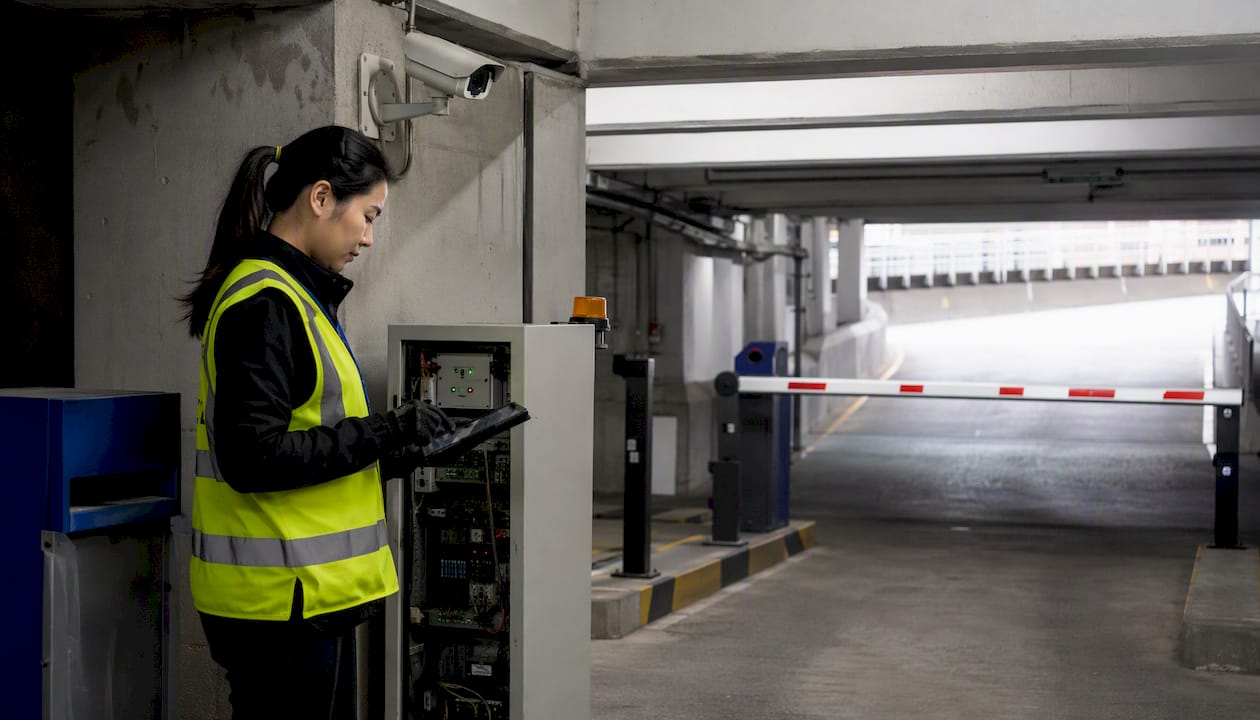
Gate cycle ratings, PARCS (Parking Access and Revenue Control Systems) integration, and LPR (License Plate Recognition) camera placement all depend on fence layout decisions made early. Bollard placement at pedestrian crossings must maintain a minimum 36-inch ADA-compliant clear path. Get these dimensions into the site plan before the fence contractor bids.
Pro Tip: Request warranty terms in writing from every bidder including workmanship coverage, manufacturer warranty on powder-coat finish, and conditions that void the warranty (such as improper anchor installation or unapproved modifications).
Maintenance expectations
Ask bidders for a written maintenance schedule. Quarterly visual inspections, annual hardware lubrication and tension checks, and 3–5-year coating touch-ups are standard. Contractors who cannot describe a maintenance program are usually not set up to support you post-installation.
Which fence material is right for your parking lot?
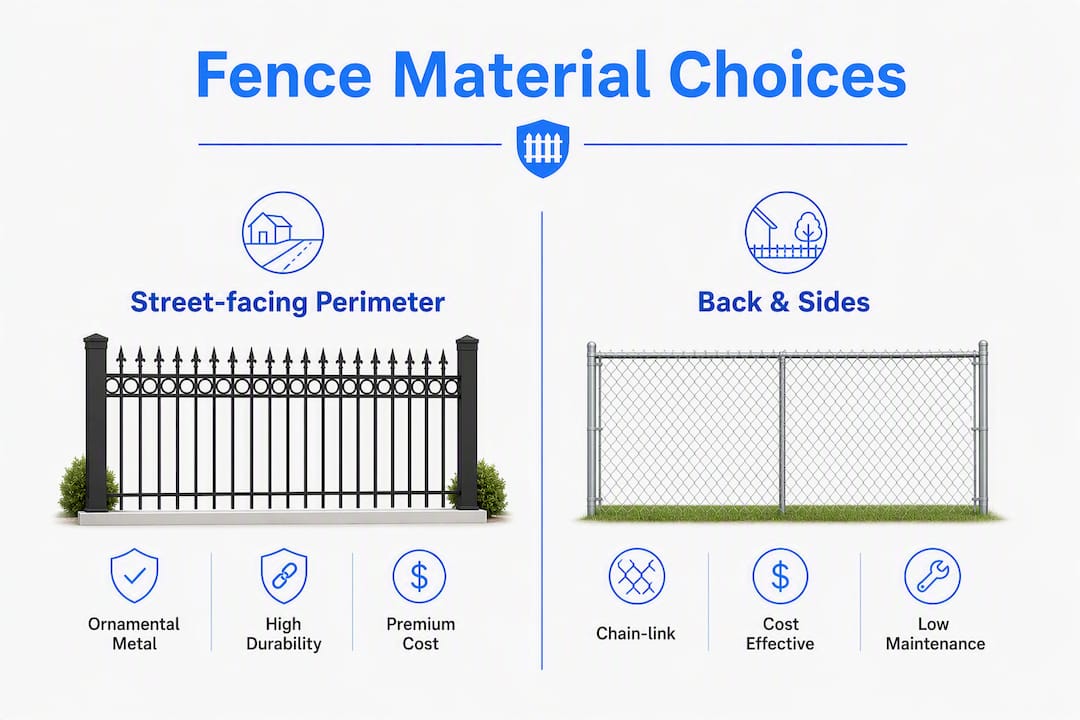
The honest answer is that most commercial sites use two materials: one for the street-facing perimeter, another for the back and sides. Here is how each option stacks up.
| Fence Type | Best For | Installed Cost ($/LF) | Durability / Corrosion Resistance | Maintenance | Visibility | Installation Type | Typical Lifespan | Access-Control Compatibility |
|---|---|---|---|---|---|---|---|---|
| Chain-link (galvanized) | Utility yards, rear perimeters, budget sites | $15–$25 | High with G90 coating; moderate in salt environments | Low | High (open weave) | Surface-mount or in-ground | 20–30 yrs | Excellent |
| Ornamental aluminum | Retail frontage, office parks, HOA-governed sites | $30 | Excellent; powder-coat resists salt and UV | Low | High (picket spacing) | In-ground preferred | 30–50 yrs | Excellent |
| Ornamental steel | High-security commercial, mixed-use | $30–$60 | Good; requires quality powder-coat | Low–moderate | High | In-ground | 25–40 yrs | Excellent |
| Welded wire / mesh | Equipment enclosures, secondary perimeters | $20–$40 | Good with galvanization | Low | Moderate | Surface-mount or in-ground | 20–30 yrs | Good |
| Vinyl / privacy panels | Screening, dumpster enclosures, noise buffers | $25 | Good; no rust, UV-stabilized | Very low | Low (opaque) | In-ground | 20–30 yrs | Limited |
| CMU / masonry wall | High-screening requirements, sound barriers | — | Excellent | Moderate (paint, caulk) | None | In-ground (footing) | 50+ yrs | Limited without cutouts |
Commercial posts are set deep and use heavier wire gauges than residential installations, making commercial pricing higher than residential for the same linear footage.
Practical use-case guide:
- Retail frontage: Ornamental aluminum fencing at 4–6 ft; open picket design preserves sight lines and satisfies most HOA requirements.
- Equipment or storage yard: 8 ft galvanized chain-link with G90 coating; add privacy slats only where code requires screening.
- Overflow or remote lot: 6 ft chain-link with a single automated slide gate; pair with LED lighting and camera coverage.
- High-security vehicle storage: 8–10 ft welded mesh or chain-link with barbed-wire topping; verify industrial zoning allows the topping.
- Customer-facing mixed site: Ornamental metal at the street, chain-link at the rear. This hybrid approach is the most common commercial solution because it balances aesthetics with cost per linear foot.
Vinyl fencing works well for dumpster corrals and utility screening where you need a clean look without painting or staining.
Surface-mount versus in-ground: which installation method fits your site?
The choice between surface-mount and in-ground footings is not just a cost question. Site conditions often make the decision for you.
Surface-mount systems use base-plate anchors bolted or epoxy-set into existing concrete or asphalt. They are the go-to when excavation would conflict with underground utilities or when the lot sits on a concrete slab with no soil access. Surface-mount installations require high-strength anchors and the correct chemical adhesive to meet wind and impact loads. Underspecified anchors near traffic lanes are a shear-failure risk. Always require the contractor to specify anchor embedment depth, anchor class, and the approved adhesive product in the bid documents.
In-ground footings place posts in concrete-filled holes, typically 30–42 inches deep for commercial applications. They provide stronger wind and impact resistance and are required by most jurisdictions for fences over 8 ft or in high-wind zones. If your site has rocky substrate or a high water table, expect additional cost for drilling or dewatering.
Site constraints to flag before bidding:
- Asphalt over a concrete slab: surface-mount only; confirm slab thickness before specifying anchor length.
- Active utility conflicts: require an 811 utility locate before any excavation; missed locates are the single most common cause of project delays.
- ADA egress paths: gate placement and post locations must not reduce pedestrian clear width below 36 inches.
- Fire-marshal access: some jurisdictions require a minimum 20-ft clear opening for emergency vehicle access; confirm with your AHJ before finalizing gate locations.
Installation checklist for bids:
- Confirm utility locate (call 811) is complete and documented before mobilization.
- Specify demolition scope: existing fence removal, asphalt patching, and debris disposal.
- Define site prep: grading tolerances, drainage accommodations, and surface repair after post installation.
- Include electrical rough-in for gate operators in the fence contractor's scope or confirm a separate electrical subcontract.
- Set a milestone schedule: material delivery, post setting, fabric/panel installation, gate hanging, operator installation, and final inspection.
- Require as-built drawings and anchor/footing documentation at project close.
How do gates, barriers, and bollards fit into your access strategy?
Gates are where parking lot security either works or breaks down. A well-specified fence with an undersized gate operator fails within months on a busy commercial site.
Gate types and tradeoffs:
- Swing gates: Lowest installed cost ($6,500–$14,500 for an automated double swing); require clear arc space on both sides of the opening. Poor choice on sloped driveways.
- Slide gates: Better for constrained sites; need lateral track space along the fence line. Automated slide gates run $8,500–$22,000 installed depending on opening size and operator class.
- Cantilever slide gates: No ground track, which eliminates the debris-and-ice clogging problem. Automated cantilever gates typically cost $4,000–$15,000+ for the gate alone, while fully integrated automated gates with access control usually run $8,000–$20,000+ depending on the site.
- Crash-rated gates: ASTM F2656 M30/M50-rated barriers for government, healthcare, or high-value sites; $35,000–$125,000+ installed.
Operator selection matters as much as gate type. Residential-class operators are rated for 10–15 cycles per day. A commercial lot with 200 daily transactions needs a commercial-class operator rated for 100+ cycles per day, with battery backup for power outages.
Bollards:
Fixed steel bollards at pedestrian crossings prevent vehicle incursion without restricting foot traffic. Space them adequately apart to block vehicle access while maintaining ADA clearance. Decorative cast-iron bollards work for retail frontage; crash-rated (ASTM F2656 / K-rated) bollards are specified for high-risk portals. ADA requires a minimum 36-inch clear path between any fixed obstacle.
Spec note: Always list gates, operators, electrical connections, safety devices (photo eyes, loop detectors), and access readers as separate line items in the bid. A single "gate" line item makes change orders invisible and bids incomparable.
How does fencing affect sight lines, pedestrian safety, and traffic flow?
A fence that creates blind corners or forces pedestrians into vehicle lanes is a liability problem, not just a design flaw. Perimeter design should limit vehicle access to 1–2 controlled portals and maintain clear view corridors throughout.
Sight-line rules to follow:
- Keep any fencing or landscaping under 3 ft within the vision triangle at driveway intersections and lot corners.
- Maintain clear view corridors between lighting poles and camera positions; opaque panels directly in front of a camera are a common installation mistake.
- Chain-link and open-picket ornamental fencing preserve natural surveillance; privacy slats and solid panels eliminate it.
Pedestrian safety:
- Bollard arrays at crosswalk entry points separate pedestrian and vehicle zones without requiring signage alone.
- Mark all pedestrian routes with painted crosswalks and maintain a minimum 36-inch clear width at every gate pedestrian bypass.
- Accessible routes must meet ADA slope and surface requirements; a gate threshold that creates a lip or grade change fails inspection.
Traffic flow:
- Swing gates need enough driveway depth that a queued vehicle does not block the public right-of-way while the gate opens.
- Slide gates need lateral clearance equal to the gate width plus 2 ft minimum; confirm this fits within your property line before specifying.
- Landscape trimming is a low-cost force multiplier: trimming overgrown landscaping and improving light reflectivity often delivers higher security ROI than adding fence height.
What permits and code checks does a commercial fence project trigger?
Regulatory surprises are the most common cause of project delays. Most U.S. jurisdictions layer multiple review processes on commercial fence projects, and commercial fence projects may trigger fire-marshal egress review, OSHA (29 CFR Part 1926) requirements during active construction, and environmental permits if the fence affects stormwater management.
Common permit triggers:
- Fence height exceeding 6 ft (most U.S. jurisdictions)
- Any masonry or CMU wall, regardless of height
- Automated or electrified gates
- Barbed wire, razor wire, or electric fence toppings
- Fences within a floodplain or near a stormwater feature
Local AHJ checks to complete before design:
- Front-yard setback rules: many municipalities require fences in front yards to be lower (3–4 ft) or restrict opaque materials.
- Vision-triangle limits: most jurisdictions prohibit fencing taller than 3 ft within specified distances from intersection corners.
- Fire-marshal access: confirm minimum emergency vehicle opening width (typically 20 ft) and that gate swing or slide direction does not block egress.
- HOA covenants: these can restrict materials, colors, and heights independently of municipal code.
Documentation to prepare:
- Stamped site plan showing fence location, setbacks, and gate positions
- Engineered drawings for runs exceeding local span limits or for fences in high-wind zones
- Proof of contractor licensing and general liability/workers' comp insurance
- Utility locate documentation (811 clearance)
Red flags that stop projects:
- Missing utility locates before excavation begins
- Gate swing clearance that encroaches on a public sidewalk or right-of-way
- Barbed wire specified in a zone where it is prohibited
- Masonry walls submitted without engineered drawings
Commercial installations commonly require stamped site plans and engineered drawings when fences exceed local height allowances or when gates affect fire-marshal egress. Contractors who pull permits and handle plan sheets reduce project delays significantly.
What does parking lot fencing actually cost?
Commercial fence installation cost varies widely depending on material, height, and site complexity. Chain-link is generally the most affordable commercial option; ornamental steel and aluminum cost more; high-security systems are at the higher end of the pricing spectrum.
| Material | Height | Installed Cost ($/LF) | Notes |
|---|---|---|---|
| Chain-link, galvanized | 6 ft | $15–$25 | Most budget-friendly; G90 spec standard |
| Chain-link with privacy slats | 8 ft | $28 | Adds screening; increases wind load |
| Ornamental aluminum | 6 ft | $30 | Low maintenance; HOA-friendly |
| Ornamental steel | 8 ft | $30–$60 | Higher strength; requires quality powder-coat |
| Welded wire / mesh | 6–8 ft | $20–$40 | Good for equipment enclosures |
| Vinyl / privacy panel | 6 ft | $25 | No rust; limited structural strength |
| CMU masonry wall | 8 ft | — | Maximum screening; longest lifespan |
One-acre worked example: A one-acre square lot has a perimeter that can be estimated for budgeting. Considering chain-link fencing and typical additional costs such as automated gates, permits, site prep, and electrical, total budgets vary widely according to site-specific factors.
Major cost drivers:
- Material tier and height (the biggest variable)
- Gate complexity: operator class, access-control integration, electrical
- Prevailing-wage labor requirements on public or government-adjacent projects
- Site prep: demolition of existing fence, grading, asphalt repair
- Permit fees and engineered drawings
- Electrical subcontract for gate operators
Pro Tip: Require line-item bids that separate fence line, gates, operators, electrical, permits, and site prep. A single per-foot number makes it impossible to compare bids or track change orders.
How long will your fence last, and what maintenance does it need?
Lifespan varies more by maintenance quality than by material alone. A galvanized chain-link fence that gets annual hardware checks and prompt repair of impact damage will outlast a powder-coated ornamental fence that is ignored for a decade.
Typical lifespans when maintained:
- Galvanized chain-link (G90 or better): 20–30 years
- Powder-coated ornamental aluminum: 30–50 years
- Powder-coated ornamental steel: 25–40 years
- Vinyl / PVC panels: 20–30 years
- CMU masonry: 50+ years with periodic paint and caulk maintenance
Annual maintenance checklist:
- Quarterly: Walk the perimeter; look for bent posts, torn fabric, missing hardware, and vegetation growing into the fence line.
- Annually: Lubricate all gate hinges, rollers, and operator hardware; check post anchor torque on surface-mount systems; inspect powder-coat for chips or bubbling.
- Every 3–5 years: Touch up powder-coat chips with manufacturer-matched paint; re-tension chain-link fabric where sag has developed; inspect footing integrity at gate posts.
Common failure modes to watch for:
- Anchor corrosion on surface-mount systems in salt-exposed environments
- Impact damage at gate posts from vehicle strikes (the most common single failure point)
- Powder-coat delamination starting at cut edges or drilled holes
- Gate operator hardware wear from exceeding cycle ratings
Warranty items to require from contractors:
- Minimum two years on workmanship
- Manufacturer warranty on powder-coat finish (typically 10–20 years for quality coatings)
- Written statement that G90 galvanization meets ASTM A392 or equivalent
- Powder-coat thickness specification (3–4 mils for high-exposure sites)
How do you choose the right fence installer for a commercial project?
The cheapest bid is rarely the right bid on a commercial project. The contractor who pulls permits, provides engineered drawings, and has installed similar projects in your jurisdiction saves more money in avoided delays than any per-foot discount.
Evaluation criteria:
- Commercial experience: ask for three references from comparable projects (similar material, gate complexity, and lot size).
- Licensed and insured: verify general liability and workers' compensation certificates; confirm the license covers commercial work in your state.
- Local AHJ experience: a contractor who has pulled permits in your municipality knows the plan-check requirements and common rejection reasons.
- Prevailing-wage capability: required on many public-adjacent or government-funded projects.
- Line-item bidding: any contractor who cannot separate fence, gates, electrical, and permits into distinct line items is not set up for commercial work.
Questions to ask during vetting:
- Who pulls the permits, and what is your experience with this jurisdiction's plan-check process?
- What is your warranty on workmanship, and what voids it?
- How do you handle change orders: written authorization required before work proceeds?
- Can you provide stamped engineered drawings if required?
- What does your post-installation maintenance plan include?
Red flags:
- Vague per-foot pricing with no gate or electrical line items
- No proof of insurance or licensing on request
- Reluctance to provide site photos or references from similar commercial projects
- Verbal-only change-order process
Advantagefencenj's commercial installation services include permit assistance and material specification support, which addresses the two areas where commercial projects most commonly stall.
Why layering fencing with lighting and video AI matters
A fence is a deterrent, not a detection system. Security "reasonableness" is determined by integrating policies, physical barriers, and technology together. A fence alone is not a security program.
The outside-in model structures this practically. Detection zones start at the perimeter fence line and extend outward. Context-aware video AI filters nuisance alarms (wind-blown debris, animals) and flags genuine threats at loading docks, remote corners, and curbside pickup zones, reducing guard burden and enabling verified remote response.
Implementation priorities:
- Lighting first: LED fixtures covering at least 30 ft from the perimeter eliminate the dark zones that make cameras ineffective. No camera placement compensates for inadequate light.
- Fence choice affects camera placement: Open-weave chain-link and ornamental picket fencing let cameras see through the perimeter; opaque panels force cameras to the top of the fence line or outside it entirely.
- Phased deployment: Start with a lighting audit and critical camera coverage at entry portals and high-risk corners. Add fence upgrades and gate integration in phase two once detection zones are mapped.
- Eliminate hiding spots: Trim tree canopies to 8 ft above grade and keep shrubs below 3 ft near the perimeter. Painting interior surfaces white to improve light reflectivity is a low-cost step that measurably improves camera performance.
Pro Tip: Before specifying fence height increases, complete a lighting audit. Dark zones and overgrown landscaping are usually the higher-priority fixes, and they cost less than adding two feet of fence height across a full perimeter.
Key Takeaways
For most commercial parking lots, the right fence combines chain-link or ornamental metal at 6–8 ft with 1–2 controlled portals, LED perimeter lighting, and a contractor who handles permits and engineered drawings.
| Point | Details |
|---|---|
| Material choice drives cost and lifespan | Chain-link runs $15–$25/LF installed; ornamental aluminum runs $30/LF; ornamental steel runs $30–$60/LF; hybrid perimeters balance both. |
| Mounting method depends on site conditions | Surface-mount suits concrete slabs but requires specified high-strength anchors; in-ground footings (30–42 in.) provide stronger wind and impact resistance. |
| Gates need commercial-rated operators | Automated cantilever or slide gates cost $4,000–$20,000+; always specify operator cycle rating, electrical, and access-control as separate bid line items. |
| Permits are non-negotiable | Most U.S. jurisdictions require permits for fences over 6 ft, masonry walls, and automated gates; missed permits stop projects. |
| Advantagefencenj covers the full scope | Advantagefencenj provides site assessment, custom design, permit assistance, and commercial installation across material types. |
The fence is the easy part
Most facility managers spend the bulk of their spec time on material and height, which are actually the most straightforward decisions. The harder calls are the ones that come after: gate operator cycle ratings, anchor specifications on surface-mount systems, permit documentation for the AHJ, and how the fence interacts with your camera coverage and lighting plan.
The instinct to over-secure is understandable, especially after an incident. But a 10 ft solid-panel perimeter that blocks natural surveillance, eliminates sight lines for your cameras, and makes customers feel like they are entering a detention facility creates its own problems. The better posture is usually a 6–8 ft open-weave or picket fence that preserves visibility, paired with good lighting and a gate system that actually matches your traffic volume.
Hybrid perimeters, where ornamental metal faces the street and chain-link handles the back and sides, are popular for a reason. They let you allocate budget where aesthetics matter and cut costs where they do not. Advantagefencenj's approach to commercial projects reflects exactly this: matching material to use case rather than defaulting to one solution across the entire perimeter.
The other thing most guides understate is the contractor selection. A fence contractor who has never pulled a commercial permit in your jurisdiction, cannot provide engineered drawings, and bids the whole project as a single per-foot number will cost you more in delays and change orders than any material upgrade would have saved.
Advantagefencenj: commercial fencing from spec to installation
Facility managers who need a perimeter that holds up, passes inspection, and looks right at the street have a shorter path than they think. Advantagefencenj handles the full commercial scope: on-site assessment, custom design across chain-link, ornamental aluminum, vinyl, and composite materials, permit assistance with local AHJs, and professional installation by licensed and insured crews. Every project includes a written warranty on materials and workmanship, and the team can integrate gate operators and access-control systems as part of the same installation.
If you are preparing an RFP or just trying to figure out what your lot actually needs, the right starting point is an on-site assessment. Request your estimate from Advantagefencenj and get a line-item proposal that separates fence, gates, electrical, and permits so you can budget accurately and compare bids fairly.
Useful sources and standards for further reading
These are the primary references used throughout this guide. Each one is worth bookmarking for permit documentation, procurement specs, and design standards.
- IFPO Parking Garage / Parking Lot Security: The International Foundation for Protection Officers' guidance on integrated parking security. Best used for building a security program framework and justifying integrated measures in procurement documents.
- Parking Professional: Parking Lot Fencing and Perimeter Design: Covers sight-line design, lighting coverage requirements, and controlled portal strategy. Use it for design standards and to support AHJ conversations.
- Spot AI: Retail Perimeter Security: Practical guidance on the outside-in security model, video AI detection zones, and low-cost site improvements. Best for phased technology integration planning.
- UseCalcPro: Commercial Fence Installation Cost Per Linear Foot: Current installed cost ranges by material and height, with notes on commercial versus residential pricing differences. Use for budget benchmarking and bid evaluation.
- FenceTrac: Parking Lot Fencing: Technical notes on surface-mount anchor specifications, chemical adhesive requirements, and system selection for concrete and asphalt substrates.
- Fence Installation Authority: Commercial Fence Installation: Covers permit triggers, OSHA construction requirements, and documentation needed for commercial projects. Use when building a permit checklist or evaluating contractor compliance capability.
- Parking BOXX: Barrier Gate Systems: Gate type overviews and cost ranges for barrier-arm and automated gate systems. Useful for access-control budgeting and operator specifications.