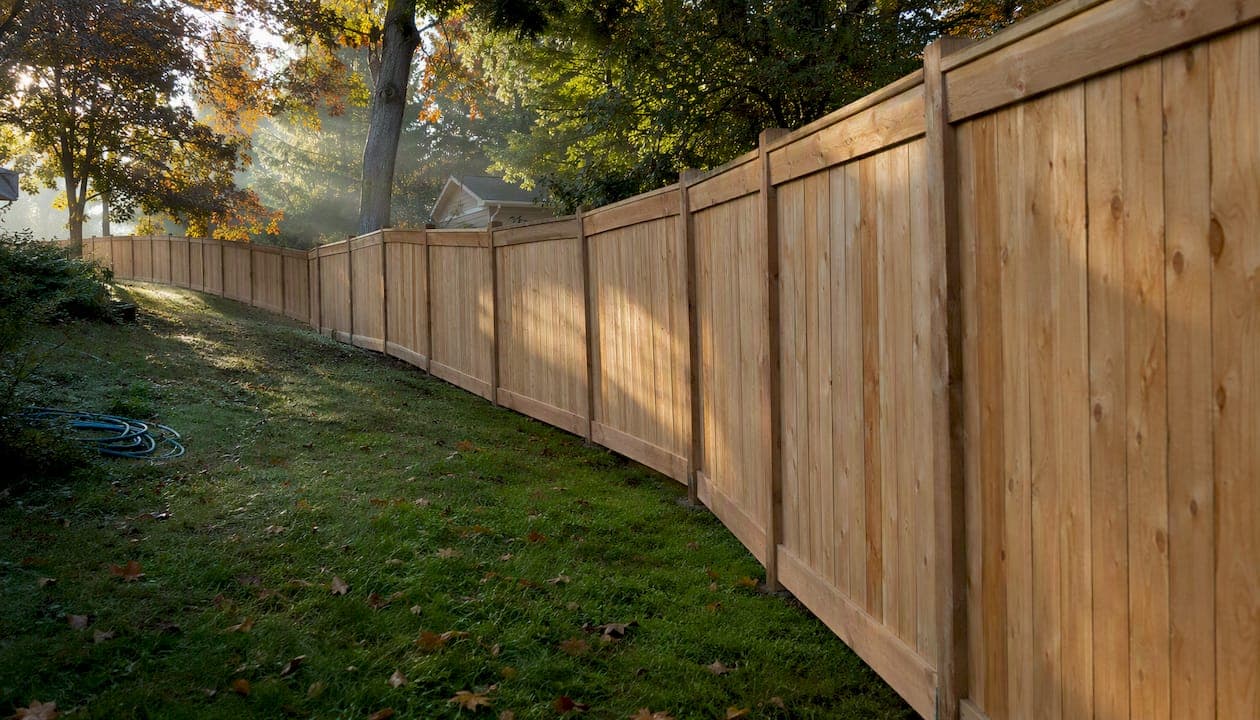
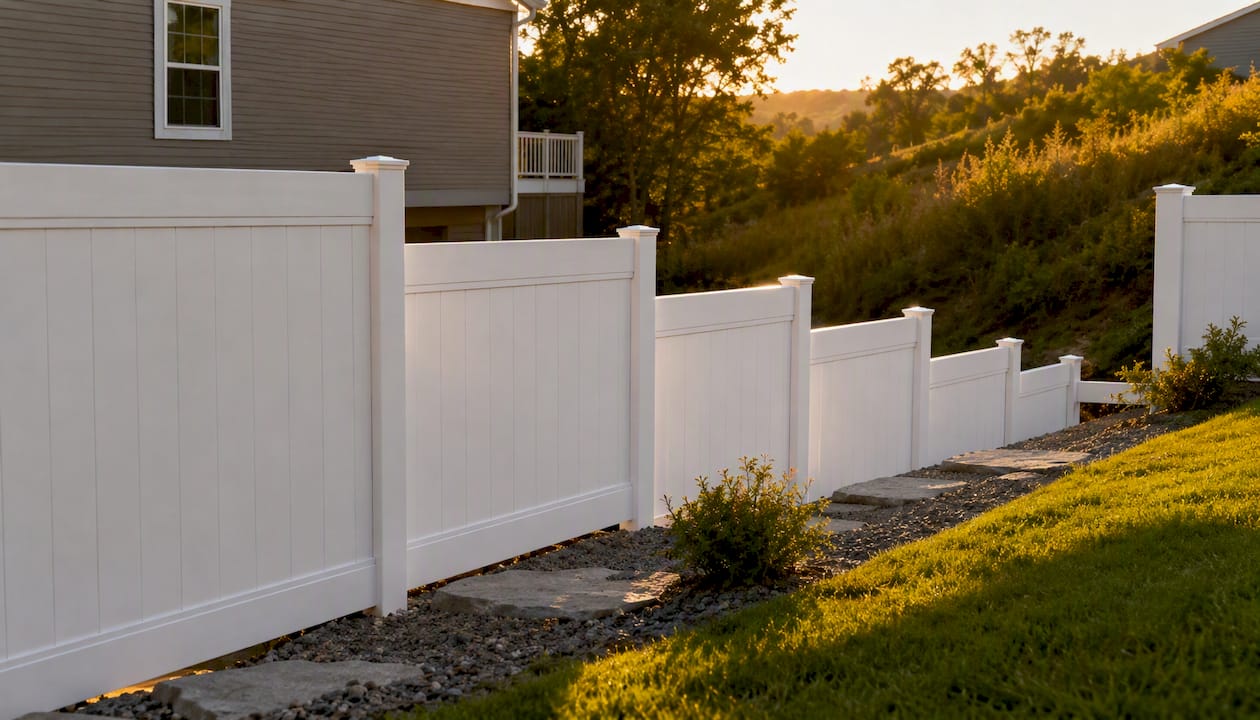
Past that, or if the ground is uneven and rocky, step it: build the fence in level sections that drop like stairs. On the steepest or most irregular lots, a short retaining wall or terrace under the fence line often solves both the fence problem and a soil problem at once. Grade above roughly 15% is where contractors start calling a job "complex," which usually means longer posts, more concrete, and possibly a different crew day rate.
Here's what to do before you call anyone:
- Walk the fence line and measure the actual drop from top to bottom, not just eyeball it.
- Check your material: chain link and wood rack easily; rigid vinyl panels usually can't, and racking them past spec voids the warranty.
Key Takeaways
Choosing between racked and stepped fencing comes down to slope grade and material flexibility, and getting post depth wrong on the low side is the most common failure point on sloped installs.
| Point | Details |
|---|---|
| Rack under 15% grade | Continuous bottom clearance works when material can flex without exceeding manufacturer rack tolerances. |
| Step steeper or irregular grades | Stair-step panels handle steep or rocky yards better but leave gaps that need filler solutions. |
| Measure from the low side | Post depth and footing embedment must be calculated from the lowest point of each hole. |
| Plan drainage before building | Keep bottom clearance around 2 inches and grade soil away to prevent the fence acting as a dam. |
| Call a pro past 15% grade | Advantage Fence handles survey, permitting, and installation for slopes where DIY risk and cost both climb. |
Table of Contents
- Fence for a Sloped Yard: Stepped vs. Racked vs. Retaining Wall
- How Do You Measure a Sloped Yard Before Fencing It?
- Setting Posts and Footings on a Slope
- Which Fence Materials Handle a Slope Best?
- Drainage and Erosion Control on a Sloped Fence Line
- Should You DIY a Sloped Fence or Hire a Pro?
- How Advantage Fence Approaches Sloped-Yard Projects
- Get a Site Visit for Your Sloped Yard Fence
- Frequently Asked Questions
- Sources
Fence for a Sloped Yard: Stepped vs. Racked vs. Retaining Wall
Two names cover most residential slope jobs: stepped (stair-step) and racked, also called contour. A third option, building the fence atop a low retaining wall or terrace, comes into play when the drop is severe enough that neither of the first two looks good or holds up.
Racked/contour fencing angles the rails and top line to follow the ground continuously, so there's no gap at the bottom. It works cleanly on gentle to moderate slopes, generally up to 12 to 15 degrees of grade, and it demands materials flexible enough to angle without cracking.
Stepped fencing keeps every panel level and drops the whole assembly down in stair-step increments. It leaves small triangular gaps under each panel, which need filler boards, gravel, or lattice. Stepping is the standard choice for steeper or more irregular grades and for prefabricated vinyl or metal panel systems that can't bend to match the ground.
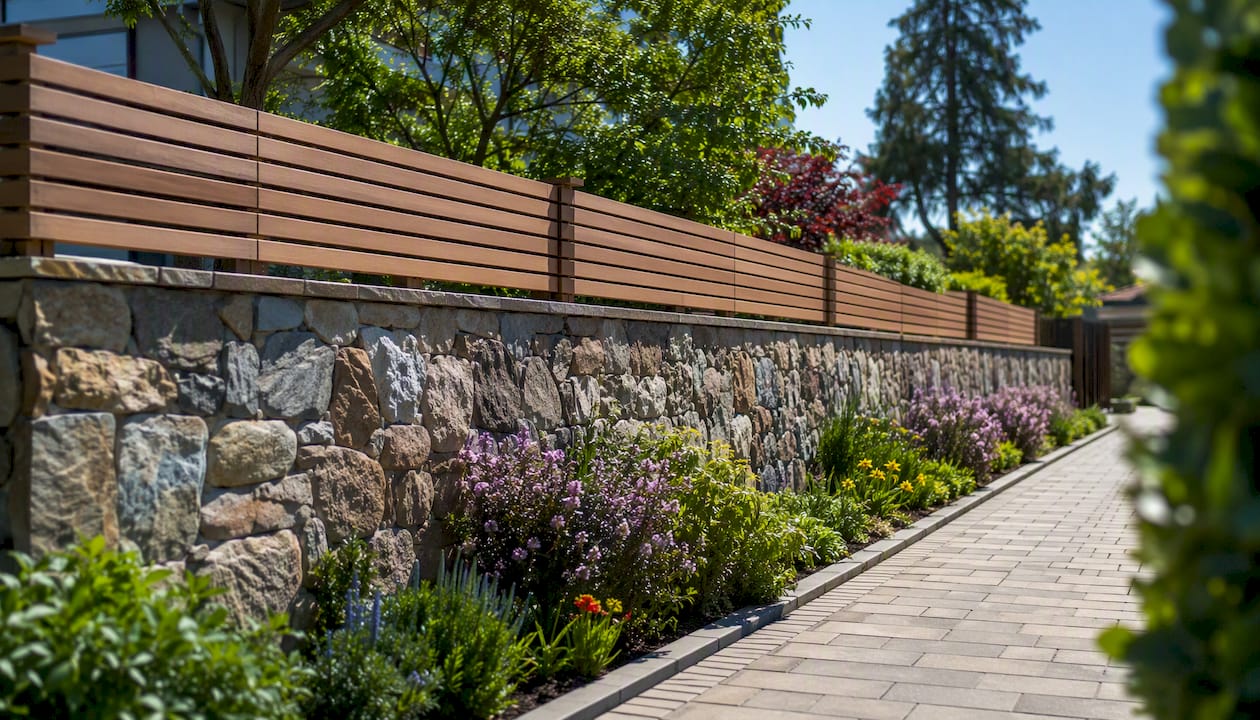
Fence-on-retaining-wall solves the problem differently: build a short wall or series of terraces, then set the fence on top of stable, roughly level ground. It costs more up front but eliminates gaps and erosion risk in one move.
| Method | Best for slope | Privacy vs. visibility | Maintenance/durability | Approx. installed cost per linear foot |
|---|---|---|---|---|
| Racked/contour | Gentle to moderate (up to ~15%) | Continuous bottom clearance, no gaps | Fewer moving parts to fail; needs flexible material | Adds roughly 5 to 15% over flat-ground pricing |
| Stepped | Steep or irregular grades | Small gaps under panels reduce full privacy | Filler boards may need occasional replacement | Moderate premium, higher with custom cuts |
| Fence-on-retaining-wall | Steep, erosion-prone, or terraced yards | Full privacy, level base | Wall adds long-term stability, needs drainage upkeep | Highest, can raise total cost 20 to 50% |
Step everything else, unless erosion or a severe drop makes a retaining wall the smarter long-term move.
How Do You Measure a Sloped Yard Before Fencing It?
Grade math isn't complicated, but skipping it is how homeowners end up with a fence that looks crooked or a permit application that gets kicked back.
- Drive a stake at the top of the slope and one at the bottom of each fence section.
- String a mason's line between them and level it with a line level.
- Measure the vertical drop from the level line down to the ground at the low stake.
- Divide the drop by the horizontal run to get percent grade (a 1-foot drop over 10 feet of run is 10% grade), then divide the total drop by your number of panels to find the step drop per section.
Before you dig anything, call 811 to have utility lines marked, and check your municipality's permit rules and setback lines. One detail people miss: measure fence height from the downhill side. Measuring only from the high side can put you over a permitted height limit without realizing it, especially on privacy fences near a pool or property line.
- Record: top elevation, bottom elevation, run length, number of panels.
- Compute: percent grade and degrees, then step drop per panel if stepping.
- Confirm: property corners, utility marks, and permit requirements before setting a single post.
Setting Posts and Footings on a Slope
Grade changes the geometry of every hole. A post that looks plumb from one angle can be leaning relative to the slope, and skipping the low-side measurement is the single most common setup error on hillside jobs.
- Dig each hole to depth measured from the lowest point of the ground around that hole, not the average or the high side.
- Follow roughly one-third of the post's total length buried below grade as your minimum, since footing depth measured from the low side keeps posts stable even where the two sides of the hole differ in height.
- Set the post plumb using a level or laser, then pour concrete, crowning the top of each footing slightly so water sheds away from the post rather than pooling around it.
- Cut or notch posts on site where fence height needs to change between stepped sections, keeping rails level within each section even as the overall line angles downhill.
Tools that make this faster: a post-hole digger or auger, a laser level, a mason's line and line level, exterior masonry screws, and adjustable rail brackets for racked sections.
Pro Tip: Buy slightly longer posts than a flat-ground job calls for. It's cheaper to cut one down on site than to discover mid-project that your embedment depth on the low side falls short of code.
Which Fence Materials Handle a Slope Best?
Not every material bends to the ground the same way. Wood and chain link flex enough to rack on moderate slopes, which is why they show up constantly on hillside lots. Rigid vinyl and most aluminum panel systems are built to spec angles, and exceeding a manufacturer's published rack tolerance can void the warranty, so stepping is usually the safer call for those materials on anything beyond a mild grade. Composite falls somewhere in between, closer to vinyl in its limits.
- Wood: Racks well up to moderate grades; easy to trim panels on site for stepped runs.
- Vinyl: Best stepped; check the manufacturer's rack-angle spec before racking at all.
- Aluminum: Some rackable systems exist; verify with the product line before assuming.
- Chain link: Highly flexible, one of the easiest materials to rack on a steep yard.
- Composite: Usually stepped, similar rigidity concerns to vinyl.
For stepped installs, common gap fixes include cut filler boards, a gravel bed, or lattice infill, and each solves a different problem depending on whether the gap is cosmetic or a real erosion risk. If a pool sits inside the fenced area, check your local pool-barrier code before finalizing the method. Also confirm HOA rules on fence height and style before ordering material, since some associations restrict visible gaps or require a flowing top line rather than a stepped one.
Drainage and Erosion Control on a Sloped Fence Line
A fence set into a hillside without a drainage plan eventually becomes a small dam, and that's when erosion problems start. Keep the bottom rail or panel edge at least 2 inches off the ground so water can pass underneath instead of pooling against the fence, and check local code for pool barriers, which often set a stricter maximum clearance.
- Grade the soil slightly away from the fence line on the uphill side.
- Fill triangular gaps under stepped panels with gravel, cut filler boards, or planted groundcover rather than leaving bare dirt exposed.
- For steep or erosion-prone sections, pair the fence with a low retaining wall or terracing, which changes post depth and footing design but stops soil movement at the source.
Rock placement and drainage channels along a steep slope are worth doing right the first time; landscaping approaches built for steep-slope stabilization pair well with a stepped fence line.
Pro Tip: Design drainage before you set a single post. Reworking soil grade after the fence is up almost always costs more than planning for water flow from day one.
Should You DIY a Sloped Fence or Hire a Pro?
That's also where cost climbs: racking alone can add 5 to 15% to labor, while steep terrain with terracing or wall work can push total installed cost up 20 to 50% over a flat-yard quote.
- Get a site visit and written estimate before committing to a method.
- Ask whether the quote includes permit filing, utility locating, and drainage planning, or if those are separate.
- Confirm warranty terms specifically for slope work, since manufacturer rack limits can affect coverage.
- Request a line-item breakdown of labor versus material and concrete costs.
- Gentle slopes: modest premium, often DIY-feasible with basic tools.
- Moderate slopes: professional grading advice recommended even if you self-install.
- Steep or irregular slopes: hire a pro, budget for extra concrete, longer posts, and possible retaining wall coordination.
How Advantage Fence Approaches Sloped-Yard Projects
A contractor walking a sloped lot runs through the same checklist every time: site survey and grade mapping, a stake plan marking top and bottom elevations, a post-depth template adjusted for the low side of each hole, a drainage detail, material selection matched to the slope's severity, and permit filing where required.
The gap under a stepped panel isn't a flaw. It's a design decision, and the right filler choice, gravel, cut board, or lattice, depends on whether you're solving for looks or for water.
Advantage Fence has handled residential, commercial, and recreational fence installations across a range of terrain, including yards that combine slope work with retaining walls and custom permitting. Field experience on uneven ground is what separates a fence that still looks straight in five years from one that starts sagging at the low corner within one winter.
- Site survey and grade stake plan
- Post-depth template matched to low-side measurements
- Drainage detail reviewed before footings are poured
- Material selection based on slope severity and local code
A Note from the Field
The most common mistake I see is measuring post depth from the average grade instead of the lowest point of the hole. It looks fine on install day and fails at the first heavy rain. That single habit is why the checklist above starts with grade mapping, not material selection.
Get a Site Visit for Your Sloped Yard Fence
Plenty of homeowners try to eyeball a slope and hope the fence panels sort themselves out, but that's how you end up with a leaning post or a gap wide enough for a dog to slip through. Advantage Fence handles the part that actually determines whether a sloped fence lasts: grade mapping, post-depth planning for the low side of every hole, and matching material to the angle you're actually working with, whether that means racking chain link or stepping vinyl panels with clean filler boards.

Our services cover the full slope project from survey through installation, including permit assistance and coordination with a retaining wall contractor when a terrace makes more sense than another step-down panel. If your yard has more than a gentle grade, request a site visit and get a written estimate before you buy a single post, and let a crew that's measured plenty of low-side holes tell you what your specific slope actually needs.
Frequently Asked Questions
What's the maximum slope for a racked fence? Beyond that, panels start binding or the top line looks visibly broken instead of smooth.
Can I mix stepped and racked sections on the same fence line? Yes. Many yards have varying grade along one property line, so a gentle stretch might rack while a steeper section a few panels over gets stepped.
Why does my stepped fence have gaps at the bottom? That's expected with stair-step construction. Fill them with cut filler boards, gravel, or lattice, and pick the option based on whether erosion or looks is the bigger concern.
Does a sloped fence cost more than a flat-yard fence? Yes, typically. Racking adds a modest premium, while steep terrain requiring terracing or a retaining wall can raise total installed cost significantly.
Do I need a permit to fence a sloped yard? Usually, and permit rules often reference fence height measured from the downhill side, so check local codes and call 811 before digging.
Sources
- Fence Installation on Slopes: Racked vs Stepped Approaches | Fence Installation Authority
- How to Build a Fence on a Slope (FenceCalc)
- How to Build a Fence on a Slope
- Fence Installation on Slopes and Uneven Terrain
This guide synthesizes standard contractor practice and manufacturer tolerances rather than a single method for every yard.